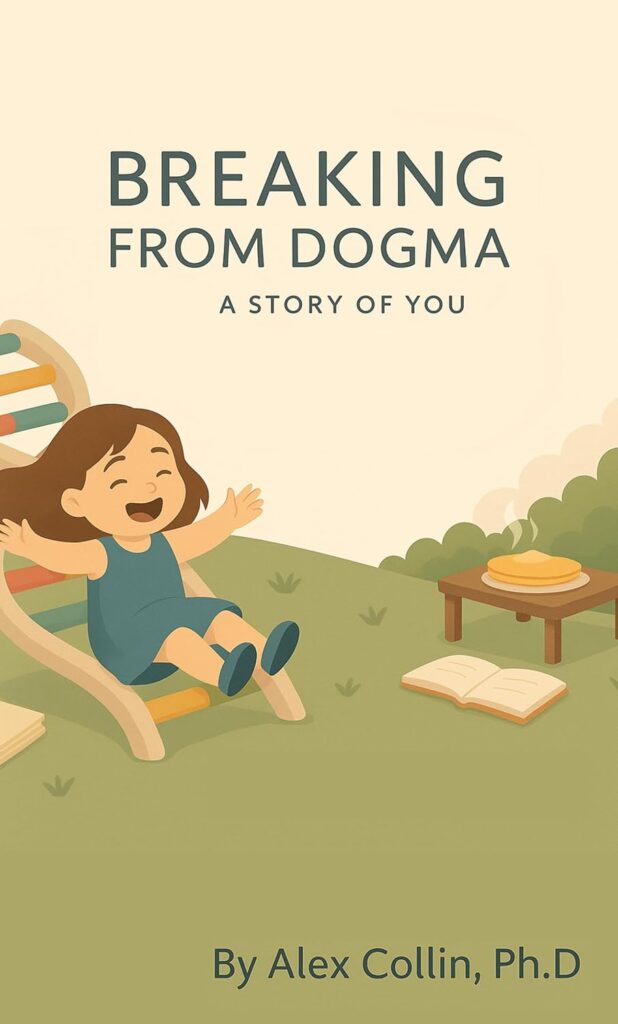
A science-inspired children’s book about DNA, epigenetics, and the amazing power of being you!
Ever wondered how your body knows what to do, or why you’re different from everyone else, even though we all start with the same recipe book inside?
Breaking from Dogma takes young readers on a beautifully illustrated journey inside the human cell to explore the big ideas of DNA, genes, and epigenetics, all explained in a warm, playful, and empowering way.
From cooking book metaphors to magical sticky notes, this story helps kids (and grown-ups too!) understand that who we are is shaped not just by our genes, but also by our environment, experiences, and choices.
- Perfect for curious kids ages 4–8
- Introduces biology, genetics, and epigenetics
- Encourages growth mindset and self-discovery
- Great for classrooms, family who love science, STEM, or storytime
Because nature and nurture don’t compete, they dance together to help you shine!
I received a complimentary copy of this book from Reedsy Discovery. I voluntarily chose to read and post an honest review.
Breaking from Dogma takes readers on an enlightening journey inside the human cell to explore DNA, genes, and epigenetic, all brought to life through engaging and captivating illustrations.
Have you ever wondered how your body knows what to do or why you’re different from everyone else? You can thank your cells for that! Breaking from Dogma informs readers that their body is comprised of trillions of cells, which make up everything, including your skin! Thanks to the artist, the audience will get a magnified look at muscle, fat, and skin cells. And, as the character looks through a microscope, we get an even closer look at a cell. In the enhanced photo, we learn what is and where you’ll find a cell’s nucleus and cytoplasm. Don’t worry if kids can’t recall their meaning; there is a glossary in the end credits for every scientific word in the story, plus several more that weren’t.
Every child’s capacity to learn, understand, and retain information varies. The book’s suggested reading age is 4-8. It’s evident the author put a lot of thought into explaining genes and the Central Dogma of Molecular Biology: DNA, RNA, and proteins for this age range. The inclusion of silly, fun, and age-appropriate artwork, such as three smiling organs reading recipe books, was a nice touch. It was just what was needed to keep readers engaged.
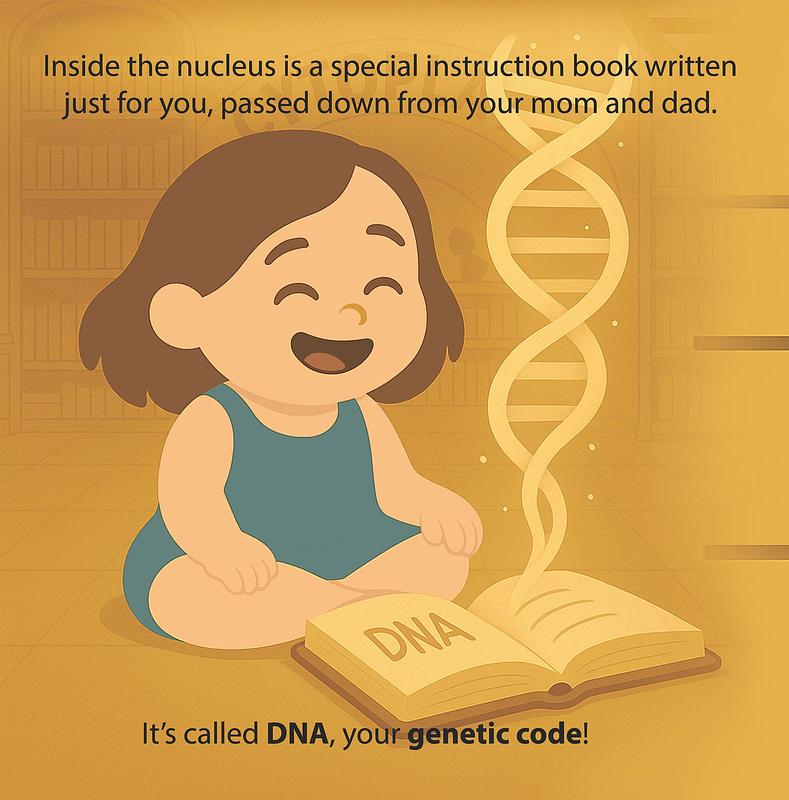
The term “epigenetic inheritance” might sound complex, but Breaking from Dogma simplifies it beautifully. “It’s a kind of memory from our ancestors experiences. A whisper from the past, living in your cells.” While the term might be challenging for young minds to retain, they should be able to remember its meaning. Especially if shown the lovely image of the little girl holding onto an illuminated DNA as she stares in awe at her three ancestors above her head. So sweet.
Breaking from Dogma is a beautifully designed book that does a good job of breaking down how DNA and life experiences work hand in hand to shape who we are. While the illustrations are catered to 4-8-year-olds, kids in this age bracket might struggle to recall or pronounce some science terms. Therefore, I recommend reading the book more than once!
Breaking from Dogma is a must-have for elementary school classrooms, homeschoolers, and families who love science. Add the book to your curriculum. Read it for fun. Increase your science knowledge or use it to refresh your brain. (Yeah, adults, I am talkin’ to you!). Learn together that our genes do not just shape us, but so do our environment, experiences, and choices.
Heart Rating System:
1 (lowest) and 5 (highest)
Score: ❤❤❤❤
Meet the Author

Alex Collin (Alexandra Collin de l’Hortet) is a biotech executive with over a decade of experience leading the development of innovative therapies in gene therapy. Raised in France and now based in the San Francisco Bay Area, she brings a unique blend of international perspective, scientific expertise, and creative curiosity to everything she writes.
As a parent of two curious young children, Alex has experienced firsthand the power of storytelling to make sense of the world. She is passionate about transforming complex scientific ideas into playful, empowering stories that children can connect with and understand.
Drawing on both a deep love of storytelling and a career at the forefront of science, Alex writes to spark wonder, build confidence, and inspire the next generation of curious thinkers.
Amazon Author Page Link
Reedsy Author Link